ASSOCIATION FOR EUSOCIAL SHRIMP RESEARCH AND DEVELOPMENT
Document registryContact & enquiries

AESRD RESEARCH ATLAS / MARINE SOCIAL LIFE

Eusocial shrimp,
mapped worldwide.

Where have eusocial shrimp been found? Explore published locations of sponge-dwelling Synalpheus shrimp, and the promising leads that still need stronger evidence.

9 documented regions3 research leadsEvidence reviewed

LOCATIONS & THE EVIDENCE BEHIND THEM

A world of small societies.

Read every record ↓
Documented eusocial colonies Research lead · unconfirmed here
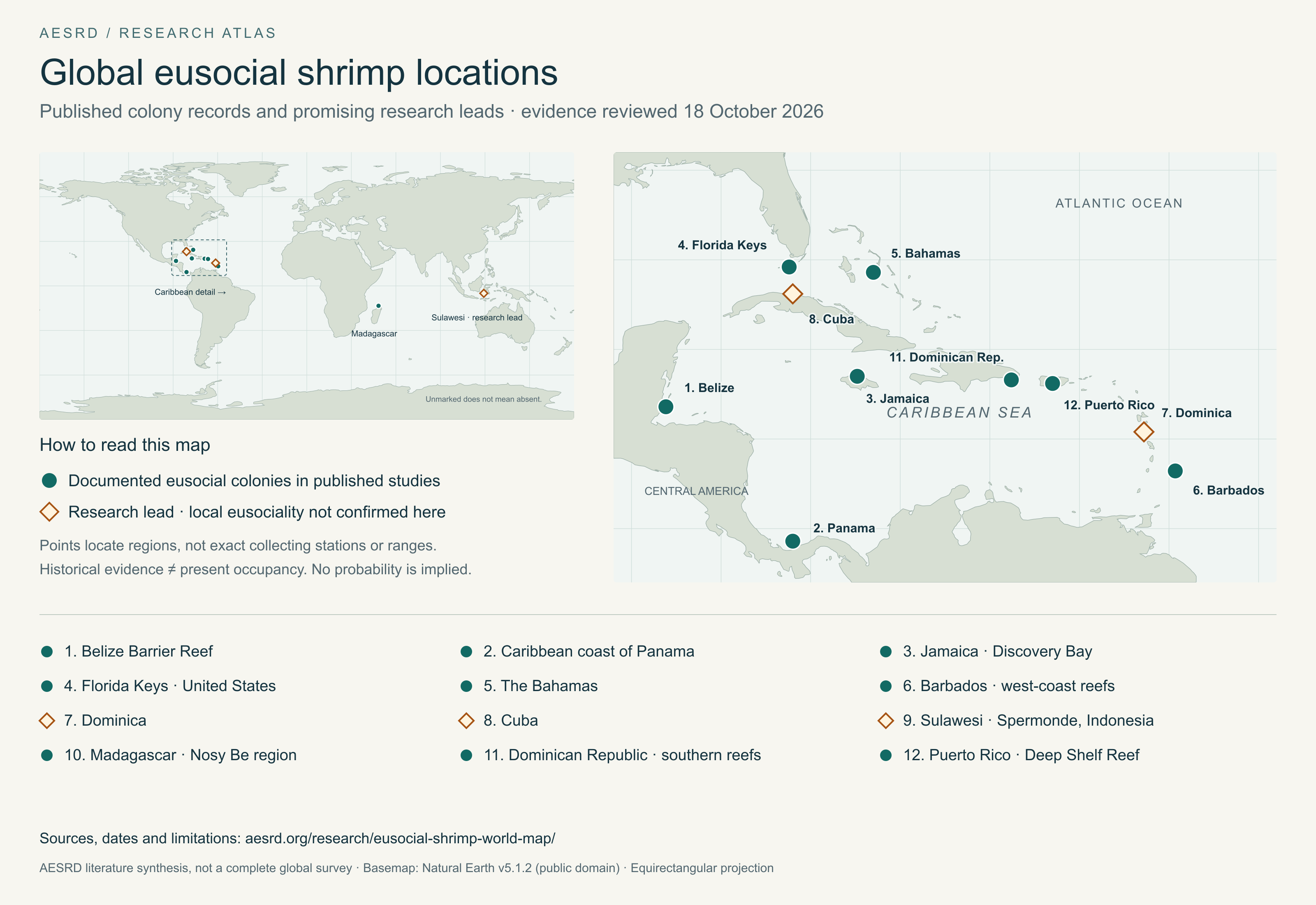
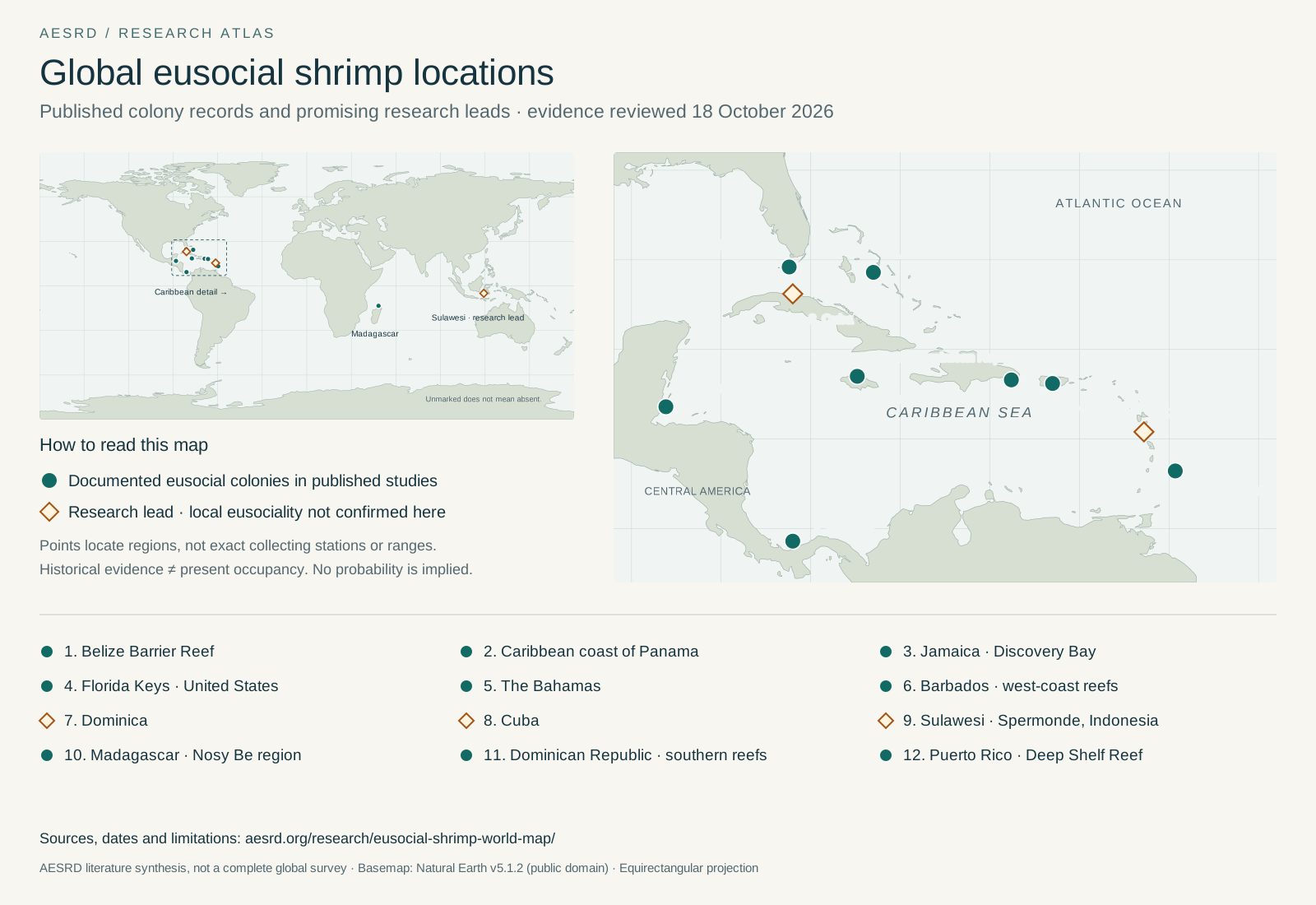
World overview of eusocial shrimp recordsTeal circles: documented eusocial colonies. Amber diamonds: research leads, not locally confirmed eusociality. Regional locators, not exact collecting coordinates. The evidence list below gives sources and dates.Caribbean detail →MadagascarSulawesi · research leadUnmarked does not mean absent.Belize Barrier Reef — documented colony recordCaribbean coast of Panama — documented colony recordJamaica · Discovery Bay — documented colony recordFlorida Keys · United States — documented colony recordThe Bahamas — documented colony recordBarbados · west-coast reefs — documented colony recordDominica — research leadCuba — research leadSulawesi · Spermonde, Indonesia — research leadMadagascar · Nosy Be region — documented colony recordDominican Republic · southern reefs — documented colony recordPuerto Rico · Deep Shelf Reef — documented colony record
Caribbean and western Atlantic detail of eusocial shrimp recordsTeal circles: documented eusocial colonies. Amber diamonds: research leads, not locally confirmed eusociality. Regional locators, not exact collecting coordinates. The evidence list below gives sources and dates.CARIBBEAN SEAATLANTIC OCEANCENTRAL AMERICABelize Barrier Reef — documented colony record1. BelizeCaribbean coast of Panama — documented colony record2. PanamaJamaica · Discovery Bay — documented colony record3. JamaicaFlorida Keys · United States — documented colony record4. Florida KeysThe Bahamas — documented colony record5. BahamasBarbados · west-coast reefs — documented colony record6. BarbadosDominica — research lead7. DominicaCuba — research lead8. CubaDominican Republic · southern reefs — documented colony record11. Dominican Rep.Puerto Rico · Deep Shelf Reef — documented colony record12. Puerto Rico

Approximate regional locators. Colours show evidence categories, not abundance or probability. Unmarked areas are not confirmed absences.

Documented eusocial colonies

Belize Barrier Reef

Eusocial Synalpheus assemblage, including S. regalis

A major study region around Carrie Bow Cay. Later surveys reported declines and local losses; this marker records historical evidence, not a current census.

Evidence
Published eusocial-colony study
Record dates
Collections reported for 1993–2005

Source trail

Documented eusocial colonies

Caribbean coast of Panama

Eusocial Synalpheus; S. duffyi described from Isla Grande

A regional marker for Caribbean Panama, including Bocas del Toro and Isla Grande. It does not indicate a Pacific-coast record or a precise collecting station.

Evidence
Published eusocial-colony studies
Record dates
Collections reported for 1988–2011

Source trail

Documented eusocial colonies

Jamaica · Discovery Bay

Synalpheus duffyi, S. elizabethae and S. regalis

Colony studies document eusocial shrimp in Jamaica. Subsequent population-change research reinforces the need to distinguish historical records from current abundance.

Evidence
Published eusocial-colony studies
Record dates
Collections reported for 2008

Source trail

Documented eusocial colonies

Florida Keys · United States

Includes Synalpheus cayoneptunus

The 2015 taxonomic study describes a eusocial species from the Florida Keys. The marker represents the island chain, not all of Florida.

Evidence
Published eusocial species and colony records
Record dates
Florida Keys species description published 2015

Source trail

Documented eusocial colonies

The Bahamas

Eusocial Synalpheus; regional record

The comparative colony study includes Bahamian material. Its regional summary does not establish occupation across the archipelago; this point is a locator only.

Evidence
Collection region in a eusocial-colony study
Record dates
Collections reported for 2001

Source trail

Documented eusocial colonies

Barbados · west-coast reefs

Synalpheus microneptunus

The species description reports small sponge-dwelling colonies, generally with one breeding female, from west-coast Barbados reefs.

Evidence
Species description and colony observations
Record dates
Collected October 2008; published 2011

Source trail

Research lead · not confirmed here

Dominica

Synalpheus riosi

The authors describe 139 specimens apparently belonging to one colony and qualify the eusocial interpretation. We retain that uncertainty: a strong lead for further behavioural and colony study.

Evidence
Presumed sociality in the cited description
Record dates
Species description published 2008

Source trail

Research lead · not confirmed here

Cuba

Synalpheus duffyi

The taxonomic study extends this species’ distribution to Cuba. Species presence is a useful survey lead; it is not, by itself, verification of a eusocial colony at this regional marker.

Evidence
Occurrence of a species known for eusociality
Record dates
Distribution record published 2015

Source trail

Research lead · not confirmed here

Sulawesi · Spermonde, Indonesia

Synalpheus neptunus neptunus (name used by the source)

A sponge sample held 289 shrimp with one egg-bearing female. The authors suggested eusociality, while behavioural division of labour remained to be established. A promising Indo-Pacific research lead, not a confirmed eusocial population.

Evidence
Suggestive colony structure; behaviour unresolved
Record dates
Study collections in 2000 and 2002; published 2006

Source trail

Documented eusocial colonies

Madagascar · Nosy Be region

Synalpheus gustavi; S. sponjy with qualified evidence

The study reports two eusocial species from northwest Madagascar. Evidence for S. gustavi includes strong reproductive skew. No breeding female was recovered for S. sponjy, whose social organization is inferred more cautiously. This is not a claim that every defining behaviour was experimentally observed.

Evidence
Published eusocial classification from colony evidence
Record dates
Collected May 2008; published December 2023

Source trail

Documented eusocial colonies

Dominican Republic · southern reefs

Synalpheus idelisae

The species description documents sponge-dwelling eusocial colonies from Dominican Republic reefs, including Dominicus, Peñon and Tortuga. This marker is separate from the island of Dominica.

Evidence
Species description and colony observations
Record dates
Collected November 2024; published September 2026

Source trail

Documented eusocial colonies

Puerto Rico · Deep Shelf Reef

Synalpheus idelisae

The same 2026 study reports colonies from Puerto Rico as well as the Dominican Republic. Colony observations, rather than species occurrence alone, support this regional entry.

Evidence
Species description and colony observations
Record dates
Collected March 2024; published September 2026

Source trail

A MAP OF EVIDENCE

What the colours
can tell us.

Teal circles identify regions with published eusocial-colony records. These are literature records, with the classification and limitations of their sources. A region is counted once; the total is neither a species count nor a count of colonies.

Amber diamonds identify promising research leads. Some reports describe suggestive colony structure; others record a species known for eusociality elsewhere. Each record explains the distinction. Amber is not a measured probability of finding a colony.

These shrimp live inside marine sponges. Finding a snapping shrimp, a sponge or a tropical reef does not by itself establish eusociality. Colony structure, reproduction, development and behaviour need careful examination. Read what makes a shrimp colony eusocial.

Grey land and unmarked water mean no record is plotted in this synthesis, not that shrimp are absent. This is a curated starting point rather than a complete survey of every reef or specimen. Historical observations do not establish current occupancy: repeat surveys have documented local losses.

KEEP THE CONTEXT WITH THE IMAGE

The map, ready to share.

Global map of eusocial shrimp locations: teal circles mark published eusocial colony records; amber diamonds mark tentative research leads. Includes a Caribbean close-up and locations in the Indian Ocean and Indonesia.
Global eusocial shrimp locations. Original AESRD literature synthesis, with a Natural Earth basemap. The image includes the evidence legend and source-page address so those qualifications travel with it.

Suggested citation: AESRD (2026). Global eusocial shrimp locations: published records and research leads. Evidence review dated 18 October 2026. Link to this page when sharing the map, and consult the primary papers for scientific use.

THE COMPLETE EVIDENCE REGISTER

Every marker has a source.

All locations and limitations remain readable without using the interactive map.

● Documented region

1. Belize Barrier Reef

Eusocial Synalpheus assemblage, including S. regalis

Collections reported for 1993–2005

A major study region around Carrie Bow Cay. Later surveys reported declines and local losses; this marker records historical evidence, not a current census.

● Documented region

2. Caribbean coast of Panama

Eusocial Synalpheus; S. duffyi described from Isla Grande

Collections reported for 1988–2011

A regional marker for Caribbean Panama, including Bocas del Toro and Isla Grande. It does not indicate a Pacific-coast record or a precise collecting station.

● Documented region

4. Florida Keys · United States

Includes Synalpheus cayoneptunus

Florida Keys species description published 2015

The 2015 taxonomic study describes a eusocial species from the Florida Keys. The marker represents the island chain, not all of Florida.

● Documented region

5. The Bahamas

Eusocial Synalpheus; regional record

Collections reported for 2001

The comparative colony study includes Bahamian material. Its regional summary does not establish occupation across the archipelago; this point is a locator only.

● Documented region

6. Barbados · west-coast reefs

Synalpheus microneptunus

Collected October 2008; published 2011

The species description reports small sponge-dwelling colonies, generally with one breeding female, from west-coast Barbados reefs.

◇ Research lead · not confirmed here

7. Dominica

Synalpheus riosi

Species description published 2008

The authors describe 139 specimens apparently belonging to one colony and qualify the eusocial interpretation. We retain that uncertainty: a strong lead for further behavioural and colony study.

◇ Research lead · not confirmed here

8. Cuba

Synalpheus duffyi

Distribution record published 2015

The taxonomic study extends this species’ distribution to Cuba. Species presence is a useful survey lead; it is not, by itself, verification of a eusocial colony at this regional marker.

◇ Research lead · not confirmed here

9. Sulawesi · Spermonde, Indonesia

Synalpheus neptunus neptunus (name used by the source)

Study collections in 2000 and 2002; published 2006

A sponge sample held 289 shrimp with one egg-bearing female. The authors suggested eusociality, while behavioural division of labour remained to be established. A promising Indo-Pacific research lead, not a confirmed eusocial population.

● Documented region

10. Madagascar · Nosy Be region

Synalpheus gustavi; S. sponjy with qualified evidence

Collected May 2008; published December 2023

The study reports two eusocial species from northwest Madagascar. Evidence for S. gustavi includes strong reproductive skew. No breeding female was recovered for S. sponjy, whose social organization is inferred more cautiously. This is not a claim that every defining behaviour was experimentally observed.

● Documented region

11. Dominican Republic · southern reefs

Synalpheus idelisae

Collected November 2024; published September 2026

The species description documents sponge-dwelling eusocial colonies from Dominican Republic reefs, including Dominicus, Peñon and Tortuga. This marker is separate from the island of Dominica.

● Documented region

12. Puerto Rico · Deep Shelf Reef

Synalpheus idelisae

Collected March 2024; published September 2026

The same 2026 study reports colonies from Puerto Rico as well as the Dominican Republic. Colony observations, rather than species occurrence alone, support this regional entry.

METHOD & LIMITATIONS

Read the record,
then the map.

This editorial synthesis groups selected primary-paper records by region. Records are classified from the evidence described in the cited studies, not inferred from map proximity, habitat suitability or general species databases. Species names follow the cited sources; some older names represent unresolved species complexes.

Coordinates in the downloads are approximate editorial locators in longitude and latitude (WGS84). They are not specimen coordinates, instructions for collecting, range boundaries or estimates of geographic uncertainty. The world and Caribbean panels use an equirectangular projection. Coastlines are simplified and small islands may be omitted.

The map is a versioned literature synthesis, not live monitoring. It has not undergone external peer review. Source-specific uncertainty is retained, and future evidence may change a marker’s category.

Basemap: Natural Earth, version 5.1.2, 1:110m world land and 1:50m Caribbean land; public-domain data. The accompanying PNG, SVG and data register are generated from the same records as the interactive map.

PRIMARY LITERATURE

Follow the evidence.

  1. Hultgren, Claire & Bailey (2026). A new eusocial species of snapping shrimp, Synalpheus idelisae n. sp. (Decapoda, Alpheidae), with a review of caste differentiation in eusocial shrimp.

    Species treatment, material examined, ecology and colony size (Table 3): 2024 colonies from the Dominican Republic and Puerto Rico. Published 8 September 2026.

  2. Ashrafi & Hultgren (2023). Eusociality unveiled: discovery and documentation of two new eusocial shrimp species (Caridea: Alpheidae) from the Western Indian Ocean.

    Species accounts and discussion: S. gustavi and S. sponjy from northwest Madagascar; eusocial classification based on colony evidence, with greater uncertainty for S. sponjy.

  3. Didderen, Fransen & de Voogd (2006). Observations on sponge-dwelling colonies of Synalpheus of Sulawesi, Indonesia.

    Table I (p. 964) and discussion (p. 973): a large colony with one egg-bearing female suggests eusociality, but behavioural division of labour is not demonstrated.

  4. Macdonald, Hultgren & Duffy (2009). The sponge-dwelling snapping shrimps (Crustacea, Decapoda, Alpheidae, Synalpheus) of Discovery Bay, Jamaica, with descriptions of four new species.

    Methods (p. 3); S. duffyi and S. elizabethae ecology (pp. 22, 24); discussion of S. regalis colonies (p. 54).

  5. Bornbusch, Lefcheck & Duffy (2018). Allometry of individual reproduction and defense in eusocial colonies: a comparative approach to trade-offs in social sponge-dwelling Synalpheus shrimps.

    Methods: Synalpheus collections and Study specimens. Lists five collection regions and the study’s eusocial species; it is not a complete range survey.

  6. Hultgren, Macdonald & Duffy (2011). Sponge-dwelling snapping shrimps (Alpheidae: Synalpheus) of Barbados, West Indies, with a description of a new eusocial species.

    Material and methods; Synalpheus microneptunus, hosts and ecology. West-coast Barbados collections, October 2008.

  7. Anker & Tóth (2008). A preliminary revision of the Synalpheus paraneptunus Coutière, 1909 species complex.

    Abstract and species accounts: S. duffyi from Caribbean Panama; S. riosi from Dominica described with explicitly qualified sociality.

  8. Hultgren & Brandt (2015). Taxonomy and phylogenetics of the Synalpheus paraneptunus-species-complex, with descriptions of two new species.

    Abstract and species accounts: S. cayoneptunus in the Florida Keys, and new S. duffyi records from Cuba and Florida.

  9. Duffy et al. (2013). Decline and local extinction of Caribbean eusocial shrimp.

    Results and discussion: repeat surveys in Belize and Jamaica. Historical records cannot establish present-day occupancy.

Explore the biology of eusocial shrimp →

A SHARED FIELD OF ENQUIRY

Good questions deserve
collective attention.

Express your interest